
Everyone has access to the same tools, with most organizations now saying they’ve invested in AI and are at least beginning to integrate it into their operations. And whether you’ve invested in AI tools for your organization or not, it’s likely that your people are using them on their own.
Data shows that merely acquiring the tools isn’t enough to see widespread results:
The scaling gap
95%
of AI pilots fail to deliver desired bottom-line returns — MIT
1 in 3
companies have started to scale their AI programs, despite 90% regularly using it — McKinsey
6%
of enterprises have made AI work at scale — Reuters Insights & Scale AI
Our own research reveals more optimistic takeaways on an individual level: 74% of employees agree that AI improves their work, and 80% can clearly articulate how it boosts their efficiency or output. Still, individual pockets of productivity won’t translate to lasting competitiveness and company-wide results. Although those early gains are real, they begin to level out as adoption spreads across companies, industries, and markets. And for too many organizations, the expected ROI doesn’t materialize.
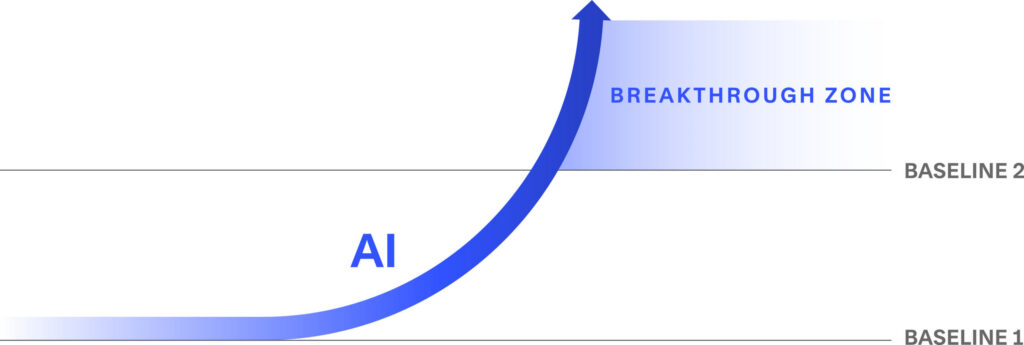
The thing is, it’s not because the technology itself doesn’t measure up. AI may be the new darling, but history always repeats itself. Early technological access yields an extraordinary edge at first. But once the tech is within everyone’s reach, the playing field becomes even again. What you thought was your competitive edge suddenly becomes table stakes.
“What you thought was your competitive edge suddenly becomes table stakes.”
As technology starts to set the baseline, the question isn’t about whether you’ll use AI or which platform is best. It’s whether your leaders have the human differentiators to raise the ceiling and create a durable AI advantage.
Same Tools, New Baseline
AI accelerates our access to information, automates routine work, and raises the standard for what everyone within an organization can deliver. Not only is it fast, but it’s evolving by the day. A capability that initially seemed like a tangible differentiator becomes old news in just a few months.
Understandably, this is where many organizations stall. The rapid pace of change feels new and unsustainable. People do move faster to try to keep up, but they’re not always moving together. And while the technology is there, the human strengths that actually make it work aren’t.
Once everyone has the same tools, the question has to shift from “What can AI do?” to “How can we help our people confidently act, decide, and collaborate with AI at speed?”
Organizations enable this shift not by investing in more AI but by investing in leadership infrastructure. By creating clarity and accountability, building trust, and supporting creative collaboration, leaders help others partner with AI to accelerate performance far beyond the baseline technology creates.
True Breakthroughs Are Led by High-Trust Leaders
Adoption happens at the speed of trust. But we’ve found that too many leaders are underinvested in trust: Two-thirds of employees have low confidence in today’s leaders overall, and just 42% view their own leaders as trusted. All told, fewer than 7% of teams describe their trust level as world-class.
Clarity and confidence go hand-in-hand with trust. We’ve identified several other friction points that hold organizations back from getting to the Breakthrough Zone:
Employee friction points
92%
spend multiple hours weekly resolving misalignment or waiting for clarity.
36%
hesitate to make decisions without manager approval.
25%
say expectations for AI use are unclear.
42%
say AI best practices aren’t consistently shared.
40%
aren’t sure how AI will affect their jobs.
46%
don’t know whether their roles will matter in the future.
FranklinCovey Institute
These aren’t technology problems. They’re unmistakably human problems. And it’s on leaders to fix them if they want to raise their ceiling above the AI baseline.
We know that when trust is low, decisions take longer, approvals multiply, rework increases, and people shy away from taking accountability and sharing information. When trust is high, people readily coordinate across functions, feel fulfilled with a sense of purpose, and don’t hesitate to act even when conditions are uncertain.
The numbers don’t lie. High-trust organizations operate differently and see a measurable performance impact:
the high-trust performance ADVANTAGE
260%
more motivation — MIT Sloan Management Review
41%
less absenteeism — MIT Sloan Management Review
8.5X
more revenue per employee — Great Place to Work Institute
These results don’t happen by accident. They don’t happen because you’ve acquired new tools or developed a new strategy, either. They happen because leaders actively engage in the behaviors that drive trust, engagement, and connection. And when the baseline inevitably shifts, it’s the enduring and human leadership components that will create your AI advantage.
Leadership Actions to Raise the Ceiling
1
Make Priorities Unmissable
We’ve worked with millions of leaders around the world, and what we’ve seen is that a very slim percentage of employees know their organization’s most important goals. Leaders need to translate big-picture strategy into a few essential outcomes and define clear ownership and measures of success for their teams. Be sure to publish them where everyone can see and contribute to them weekly. When teams know what matters most and how progress is measured, they volunteer their best efforts consistently and use tools mindfully to amplify the right work.
2
Empower People With High Trust
Human judgment and decision-making can’t be replaced by large language models. And while great leaders don’t micromanage their teams, they also need to take a more active role when it comes to AI. We’ve found that 80% of employees describe their manager’s approach to AI leadership as “hands-off.” When leaders empower their teams to make thoughtful decisions with established guardrails in mind, rather than completely outsource their critical thinking skills or wait hours for permission, they can close the loops to boost confidence and turn delay into momentum. Once guardrails are established, leaders can confidently extend trust for team members to experiment and learn with AI, instead of avoiding the technology due to fear of perceived failure.
3
Design Collaboration for Complexity
In the Wild West of AI, work can feel siloed and isolating. Tools may be shared, but playbooks and wins may not be. Information falls through the cracks. People feel disconnected and disengaged. But leaders who share contexts, address risks, and commit to handoffs across teams and functions will improve coordination, collaboration, and shared wins. Even in remote settings where teams don’t share the same physical space, proximity can become a leadership performance lever. When leaders share as much information as they can and provide their teams with both the context and opportunity to work collaboratively, they can accelerate outcomes rather than create redundancy or parallel effort.
4
Build a Learning Rhythm
Too often, leaders fail to connect the dots. In our research, only 9% of employees say their manager has explained how AI will help the business grow. Meanwhile, just 36% of employees who do receive AI training say it made them better. Learning can’t be a one-and-done task; it needs to be constantly reinforced with feedback loops, 1-on-1 conversations, team dashboard reviews, and insights shared from across the company. When leaders create the conditions for focus, curiosity, and accountability, they model the human capabilities their teams need to harness technology and develop a distinct AI advantage.
Lead Different to Go Beyond the Baseline
AI is no longer a vague concept that your organization needs to prepare for. The tools are here, and they’re becoming increasingly commonplace. Even as new ones emerge, they won’t serve as anyone’s ultimate differentiator for long. Your organization’s AI advantage will emerge from how your leaders create trust, clarity, collaboration, and execution at scale.
Those uniquely human capabilities will lift everyone up beyond the baseline to achieve a breakthrough that will endure beyond the next wave. But that only happens if leaders stop leaning on the tech and start leaning into what separates us from the machines.
Go deeper
Get the full report
Read AI Transformation & The Human Imperative, FranklinCovey’s full research report on what separates AI activity from AI performance.
Lead Different. Learn how at LeadDifferent.ai